
Celebrate the International Day of Women and Girls in Science with STARS EU
February 6, 2026
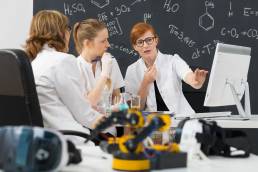
The alliance demonstrates its commitment to full and inclusive participation of women in scientific and technological fields through Women in Science
Every year, on February 11, the world commemorates the International Day of Women and Girls in Science, an official United Nations celebration dedicated to promoting full and equal participation in STEM fields. This day highlights the achievements of women in science and raises awareness of the gender gaps that still persist.
Despite significant progress in recent years, the gender gap in science remains a reality, both globally and in the European Union. The most recent data confirm that, despite advances, gender inequality in science persists. Worldwide, only one in three researchers is a woman, reflecting structural underrepresentation. In the European Union (EU), women represent 34 % of research personnel, according to the She Figures 2024 report.
Women Graduates
In higher education, women are the majority among graduates at bachelor’s and master’s levels, even in Science, Technology, Engineering, and Mathematics (STEM) fields. However, this trend weakens in later stages of scientific careers. Although women make up 48 % of doctoral students, they are less likely to pursue these studies (8 % compared to 11 % of men).
Female representation varies significantly by field. Women are the majority in Education, exceeding 60 % of doctoral graduates, while remaining underrepresented in Information and Communication Technologies and Engineering, where they do not reach 40 %. Furthermore, since 2018, there has been a decline in female presence in disciplines such as physical sciences, mathematics, and statistics.
In the labour market, women constitute only 25 % of self-employed professionals in science, engineering, and ICT. This inequality is more pronounced at the highest levels of academic careers, where women occupy only 30 % of top academic positions (grade A), even in areas where they are more prevalent at earlier stages.
Persistent Challenges
Despite advances in access to education, women still face obstacles such as lack of funding, gender stereotypes, and discriminatory practices in the workplace. This exclusion limits collective capacity to address global challenges such as climate change, public health, or space security. In this context, the UN Secretary-General, Antonio Guterres, has reiterated the need for more women scientists, especially in STEM fields.
This year, the theme of the International Day of Women and Girls in Science 2026 is: “Synergy between AI, Social Sciences, STEM, and Finance: Building Inclusive Futures for Women and Girls,” emphasizing the importance of gender equality in emerging technologies.
Women in Science
To celebrate this day and demonstrate its commitment to inclusive participation of women in scientific and technological fields, STARS EU presents Women in Science, a series of interviews highlighting brilliant women who drive scientific progress daily across its nine associated institutions. This initiative calls on the university community to continue working towards a more equal and inclusive world.
From February 11 until March 8, coinciding with International Women’s Day, nine individual video portraits will be shared, each dedicated to a STARS EU researcher whose work embodies the spirit of this international commemoration. Whether in cutting-edge technologies, public policy, social analysis, or sustainable solutions, these scientists showcase the impact and potential of women in science.
The videos will feature their career journeys: what motivated them to become researchers, the challenges they have faced, and the advice they offer to young women and girls considering a scientific career.
Their stories offer an opportunity to reflect and share ideas on how far we have come, but also on how much work remains. Their experiences demonstrate that science progresses when every voice can contribute.

Related Posts
STARS EU welcomes two new international degree pathways through cooperation between UAMD, IPB and ULL
Both the double degree in Accounting and the dual doctoral programme in Law…

The STARS EU annual meeting began in Opava, focusing on teaching innovation
The annual conference of the STARS EU alliance was inaugurated yesterday,…
STARS EU places education at the heart of Europe’s future in its third annual conference
The event, to be held at Silesian University in Opava, will take place from 25…